Veteran Benefits Scam
How fraudulent companies and impersonators charge veterans for free benefits, steal their identities, and exploit service-connected trust
Veterans are entitled to free claims assistance through accredited VA-recognized organizations. Fraudulent companies that charge fees for this assistance are not only scamming veterans financially - they are often providing poor or harmful representation that can delay or reduce legitimate benefits.
In This Guide
- Overview of the Scam
- How the Scam Works
- Common Variations
- Example Scam Messages or Pop-Ups
- Warning Signs
- Who Scammers Often Target
- What the Scammer Is Trying to Achieve
- What To Do If You Encounter This Scam
- If You Already Paid or Shared Information
- How To Prevent Veteran Benefits Scams
- Final Safety Advice
Overview of the Scam
Veteran benefits scams target the men and women who have served in the military by exploiting the complexity of the VA benefits system, the deep sense of service-based identity that makes veterans responsive to military-adjacent messaging, and the fact that many veterans are unaware of the full scope of benefits they are entitled to - or the free resources available to help them access those benefits.
These scams range from companies that charge fees for VA claims assistance that is legally required to be free, to outright fraudsters who impersonate VA officials to steal personal information, to pension poaching operations that convince elderly veterans to transfer assets to qualify for benefits they may not even need or want.
A foundational piece of knowledge that protects veterans from the most common form of this scam: accredited claims agents and Veterans Service Organizations (VSOs) are legally required to provide VA claims assistance at no charge. Any company that charges a fee to file or manage a VA disability claim is either operating illegally or providing services of questionable value that duplicate what free resources already offer.
How the Scam Works
The most common veteran benefit scam - fee-charging claims assistance - works by exploiting the complexity of the VA claims process and veterans' uncertainty about what they are entitled to.
- A company contacts a veteran by mail, email, phone, or social media advertising, offering to help them file or appeal a VA disability claim. The marketing often uses military imagery and language that resonates with veterans and implies the company has specialized expertise or connections within the VA system.
- The company charges an upfront fee, a percentage of future benefit awards, or both - framing this as reasonable compensation for navigating the complex claims process on the veteran's behalf. The veteran may not know this service is available for free through accredited VSOs.
- The company files a claim - often using a standard template - and takes credit for any award the veteran receives, regardless of whether their involvement made a meaningful difference. In some cases the representation is actively harmful, with improperly filed claims that delay or reduce legitimate awards.
- In more aggressive versions, the company requires the veteran to sign a power of attorney giving them authority over VA communications, then uses this access to redirect benefit payments or make decisions on the veteran's behalf without adequate consultation.
- The veteran has paid for something that was available for free - and may have received inferior representation that cost them time, money, or benefit amounts they were entitled to.
Common Variations
Veteran-targeted scams take several forms beyond fee-charging claims assistance.
- VA impersonation calls: A caller claims to be from the VA and asks for your Social Security number, military service number, or financial information to "update your records," "process a benefit increase," or "verify your identity." The VA does not cold-call veterans to request this information.
- Pension poaching: A financial advisor or attorney convinces an elderly veteran or surviving spouse to transfer their assets into a trust or annuity that supposedly qualifies them for Aid and Attendance pension benefits. The financial product often has high fees, surrender charges, and may actually disqualify the veteran from other benefits they currently receive.
- Fake charities for veterans: Organizations using military-themed names solicit donations claiming to support veterans but direct very little of the funds raised to actual veteran services. Verifying through Charity Navigator before donating to any veteran-focused charity is essential.
- Predatory lending targeting veterans: Payday lenders and high-interest loan companies specifically target military members and veterans, sometimes using military-adjacent branding to appear more legitimate. The Military Lending Act provides specific protections that cap interest rates for active duty members - but veterans are not always protected by the same rules.
- Benefits buyout scams: A company offers veterans a lump sum payment in exchange for signing over a portion of their future VA disability payments. These arrangements are illegal under federal law but continue to be offered to veterans who are unaware of the prohibition.
Example Scam Messages or Pop-Ups
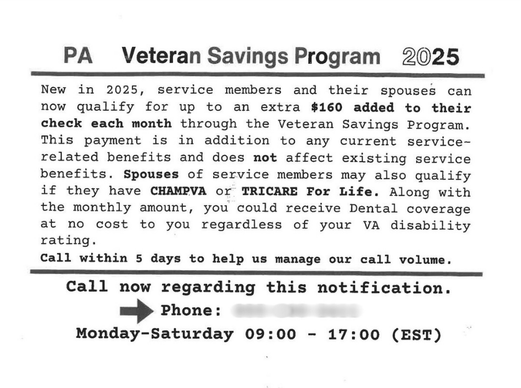
The example below shows the type of marketing used by fee-charging VA claims companies. The military imagery, the promise of specialized expertise, and the implied complexity of the claims process are all designed to make the fee feel justified.
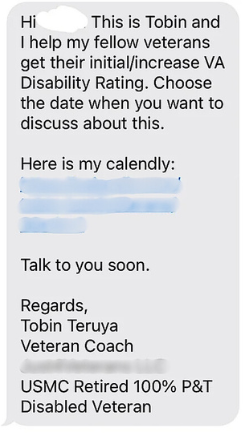
The advertisement emphasizes the complexity of the VA system and implies that paid professional assistance produces significantly better outcomes than the free resources available through accredited VSOs. In practice, accredited VSO representatives are trained specifically in VA claims and have established relationships with VA regional offices - often producing outcomes comparable to or better than paid services, at no cost to the veteran. The complexity of the system is real; the necessity of paying for help navigating it is not.
Common language includes: "VA claims are complex - don't leave money on the table. Our specialists have helped thousands of veterans maximize their disability ratings," "Most veterans are owed more than they receive - let our team review your case for a potential upside," and calls claiming: "This is the VA calling to inform you of a change in your benefits - please confirm your Social Security number to proceed."
Warning Signs
These signals indicate a veteran-targeted contact or offer may be fraudulent or predatory.
- A company charges any fee - upfront, monthly, or a percentage of your benefit award - to file or manage a VA disability claim on your behalf. This is a strong indicator of an illegal or predatory operation.
- A caller claims to be from the VA and asks for your Social Security number, military service number, or financial account details. The VA does not make unsolicited calls requesting this information.
- A financial advisor recommends transferring your assets into a trust or annuity specifically to qualify for VA Aid and Attendance benefits, without fully explaining the costs, surrender periods, and potential impact on other benefits.
- A charity for veterans cannot be verified through Charity Navigator or GuideStar, or directs a very small percentage of funds raised to actual veteran programs.
- A company offers to buy your future VA disability payments for a lump sum. This is illegal regardless of how it is presented.
- The company's marketing is heavy on military imagery and patriotic language but light on specific details about their accreditation, VA recognition, or track record with verifiable outcomes.
Who Scammers Often Target
Veterans who are in the process of filing or appealing VA disability claims are the primary target of fee-charging claims companies. Veterans who have been denied claims or who have received ratings they believe are too low are particularly vulnerable because they are frustrated with the system and more likely to believe that paid professional help will produce better results.
Elderly veterans and surviving spouses are targeted by pension poaching schemes because they are more likely to have accumulated assets and may genuinely benefit from Aid and Attendance - making the initial conversation about the benefit seem helpful rather than exploitative.
Veterans who are not connected to VSOs or VA-recognized advocacy organizations are at higher risk across all categories because they are less likely to know what free resources exist and less likely to have a trusted advisor who can identify problematic offers before harm occurs.
What the Scammer Is Trying to Achieve
Fee-charging claims companies seek ongoing fees or a percentage of benefit awards - sometimes for years - for services that could have been obtained for free. Pension poachers seek commissions and management fees from financial products that provide little genuine benefit to the veteran. VA impersonators seek personal information for identity theft. Fake veteran charities seek donations that fund their operations rather than veteran services.
Across all variations, the scam exploits the specific trust and vulnerability of veterans - their sense of deserving the benefits they earned, their unfamiliarity with a complex system, and their responsiveness to military-adjacent framing that makes offers appear more legitimate than they are.
What To Do If You Encounter This Scam
If you are a veteran seeking benefits assistance or have been approached by a company offering it, here is how to protect yourself.
- Contact a VA-accredited VSO for free claims assistance before engaging any paid service. The American Legion, VFW, DAV, and many others provide this at no charge. Find accredited VSOs at va.gov/vso.
- If a caller claims to be from the VA, hang up and call the VA directly at 1-800-827-1000 to verify whether any action is actually needed on your account.
- Before working with any financial advisor on VA pension-related asset planning, consult independently with an accredited VA attorney or VSO representative who can advise on whether the proposed financial product is appropriate and whether it may affect your existing benefits.
- Verify any veteran-focused charity at charitynavigator.org before donating. Look specifically at the percentage of funds that go to program expenses versus administrative and fundraising costs.
- Report suspected veteran benefit fraud to the VA Inspector General at va.gov/oig or by calling 1-800-488-8244.
How To Prevent Veteran Benefits Scams
The most protective knowledge is knowing what free resources exist before you ever need them.
- Know your free options. Every veteran in the US is entitled to free VA claims assistance through accredited VSOs. Connect with one before filing any claim so you understand the process and have support you trust.
- Verify accreditation. Anyone assisting you with a VA claim should be accredited through the VA. You can verify accreditation at va.gov/ogc/apps/accreditation/index.asp.
- Never pay a fee or assign a percentage of your benefits to anyone for VA claims assistance. This is illegal and unnecessary - free, accredited help is always available.
- Be skeptical of financial products presented in the context of VA benefit eligibility. Get independent advice from a VSO or an elder law attorney before signing anything that involves transferring assets.
- Stay connected to your VSO or local VA resources. Veterans who maintain ongoing relationships with accredited advocates are far less likely to be successfully targeted by fraudulent offers.
Final Safety Advice
Veterans have earned every benefit they are entitled to through their service. The scams described in this guide do not just cost money - they exploit the service, sacrifice, and trust of people who deserve better. Understanding that free, accredited assistance is always available is one of the most practically important pieces of knowledge a veteran can have.
If you need help with a VA claim, start with an accredited VSO. If you are approached by a company charging fees for this service, decline and report it. If a financial advisor recommends complex asset transfers in connection with VA benefits, get independent advice first. These steps require very little time and provide substantial protection.
The VA Inspector General's office takes veteran fraud seriously and actively investigates these cases. Your report does not just protect you - it protects other veterans who may be targeted by the same operation. Reporting is one of the most direct ways to turn a harmful experience into protection for your fellow veterans.