
Social Security Scam
How fake Social Security messages and calls pressure people into sharing personal information or sending money
Fraudsters impersonate the Social Security Administration to create panic and pressure people into acting before they have time to think.
In This Guide
Overview of the Scam
A Social Security scam is a type of fraud in which someone pretends to be an official from the Social Security Administration - or another government agency - and contacts you with urgent or alarming news about your Social Security number or benefits. The goal is to convince you to provide personal information, send money, or both.
These scams rely on the weight that government agencies carry in everyday life. Most people take a call or message claiming to be from the Social Security Administration seriously. Scammers know this, and they use official-sounding language, fake badge numbers, and manufactured urgency to make the situation feel real and immediate.
Social Security scams consistently rank among the most reported fraud types in the country, causing significant financial harm and identity theft consequences that can take months to untangle.
How the Scam Works
The encounter typically begins with an unexpected contact - most often a phone call, but sometimes a text message, email, or even a recorded voicemail. The approach tends to follow a recognizable sequence.
- You receive a call or message from someone claiming to be a representative of the Social Security Administration, the Office of the Inspector General, or another official-sounding government body. The caller ID may appear to show a real government phone number, which can be faked using widely available software.
- The caller delivers alarming news: your Social Security number has been suspended, linked to criminal activity, or used to open fraudulent accounts. They may mention specific details - such as a state name, a drug-related crime, or a dollar amount - to make the claim feel more credible.
- They tell you that unless you act immediately, your bank accounts will be frozen, a warrant will be issued for your arrest, or your benefits will be permanently revoked. The sense of urgency is deliberate and designed to prevent you from pausing to verify anything.
- To resolve the situation, they ask you to confirm your Social Security number, date of birth, or other personal details. Some scammers ask you to transfer money to a safe account, purchase gift cards and read the numbers aloud, or send funds via wire transfer or cryptocurrency to protect your assets during an investigation.
- If you comply, the scammer either uses your information to commit identity theft, keeps the money, or both. In some cases, a follow-up call from a supposed supervisor or law enforcement officer is used to extract even more.
The Social Security Administration does not suspend Social Security numbers. It does not threaten arrest. And it never asks for payment in gift cards, wire transfers, or cryptocurrency. These are reliable indicators that a communication is fraudulent.
Common Variations
While the impersonation of the Social Security Administration is the most common form, this type of scam takes several different shapes.
- Suspended Social Security number: The caller claims your number has been linked to criminal activity and must be reactivated through a verification process that requires you to confirm personal details or pay a fee.
- Benefits termination threat: You are told that your Social Security benefits are at risk of being cut off unless you call back immediately or provide certain information to verify your account.
- Arrest warrant notice: The scammer poses as law enforcement and claims that a warrant has been issued in your name due to unpaid debts or crimes connected to your Social Security number, and that paying a fine will resolve the matter.
- Safe account transfer: The caller, posing as a government official or bank investigator, instructs you to move your money into a temporary account or buy gift cards to protect it while an investigation takes place.
- Text and email versions: Instead of a phone call, some variations arrive as text messages or emails with links to fake government websites, or with instructions to call a number that connects to a scam call center.
- Overpayment recovery: You are told the Social Security Administration has overpaid you and that you must return the funds immediately through an unusual payment method such as gift cards or a wire transfer.
Example Scam Messages or Pop-Ups
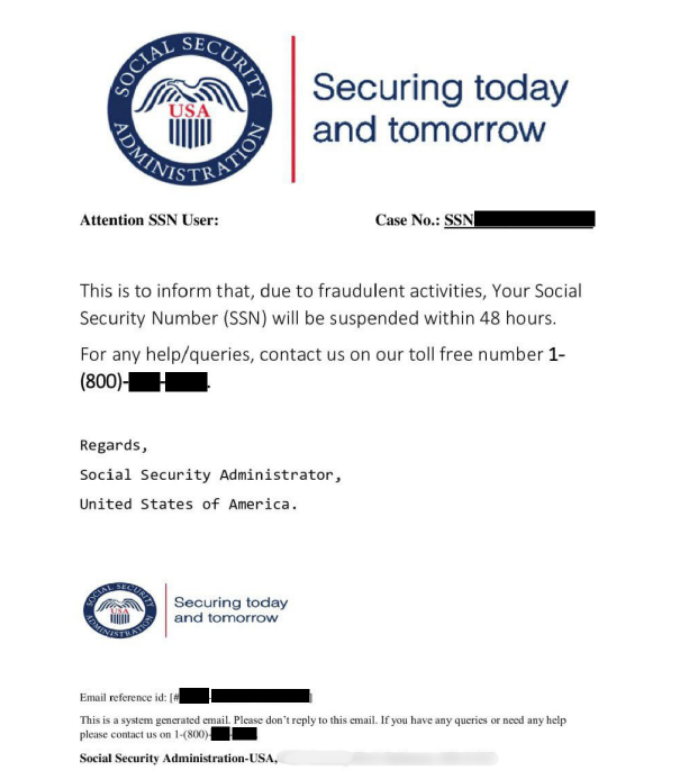
The screenshot below is a real example of the type of message or visual used in Social Security scams. These communications are designed to look and feel like they come from a legitimate government source. Knowing what to look for makes them much easier to recognize.
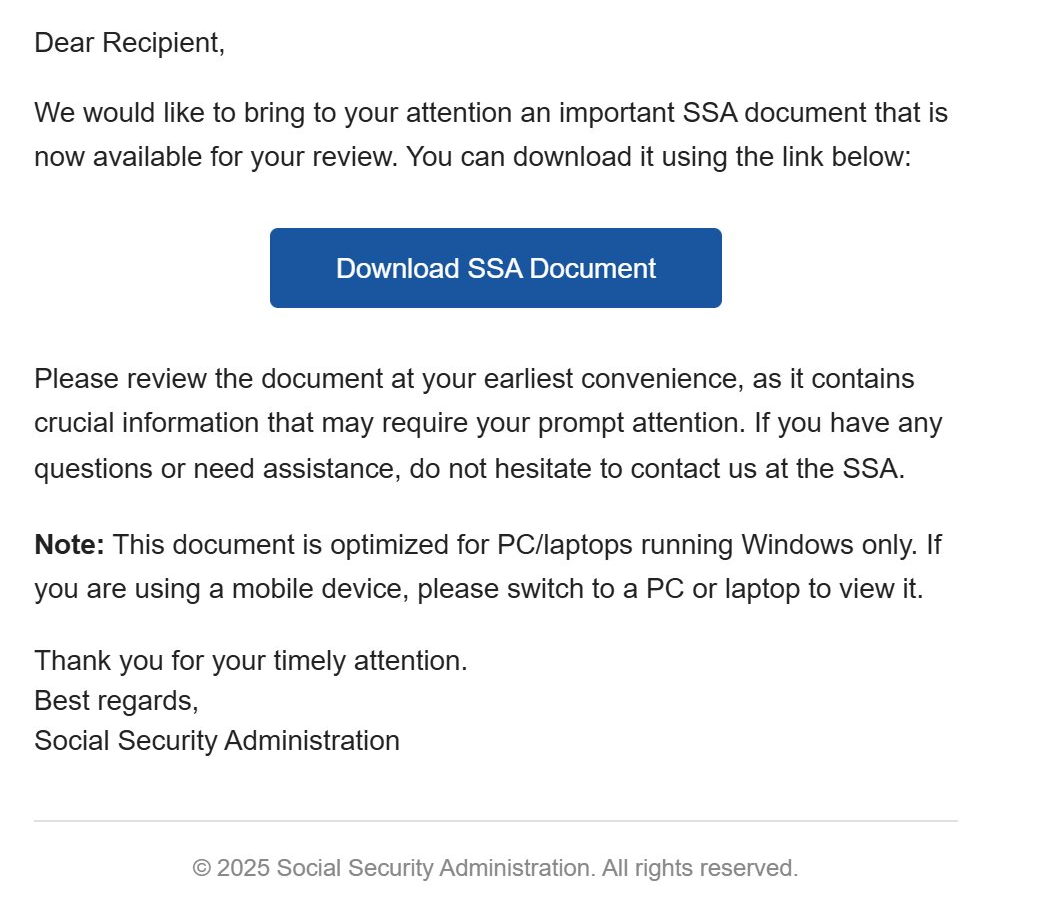
Notice the official-sounding language, the reference to criminal activity or account suspension, and the pressure to respond immediately. Legitimate government agencies do not communicate this way - they send written notices by mail and never demand immediate payment or personal details over the phone.
Common phrases used in these scam messages include: your Social Security number has been suspended, criminal activity has been detected on your account, failure to respond will result in your arrest, press 1 to speak with an officer immediately, and your assets will be seized unless you act now. These phrases are carefully chosen to provoke a sense of crisis and bypass careful thinking.
Warning Signs
The following signs are strong indicators that a contact claiming to be from the Social Security Administration or a related agency is not genuine.
- You receive an unexpected call, text, or email claiming there is a problem with your Social Security number or benefits, especially if you have not recently contacted the agency yourself.
- The message or caller uses urgent or threatening language, such as warnings about imminent arrest, account suspension, or legal action if you do not respond immediately.
- The caller asks you to confirm your Social Security number, date of birth, bank account details, or other sensitive personal information over the phone.
- You are asked to pay a fee, fine, or deposit using gift cards, wire transfer, cryptocurrency, or any other non-standard payment method.
- The caller instructs you to keep the call confidential and not to tell family members, your bank, or a lawyer about the situation.
- The caller ID displays a government phone number. This does not guarantee the call is legitimate - phone numbers can be spoofed to display any number, including real government lines.
- You are told to stay on the phone while you drive to a store to purchase gift cards, or while you initiate a wire transfer.
- The caller offers to provide a badge number or case number that sounds official but cannot be verified through any public government source.
Who Scammers Often Target
Social Security scams are designed to reach a broad audience, but certain groups are contacted more frequently and may be at higher risk of being taken in by the approach.
Older adults are disproportionately affected. Scammers target this group in part because they are more likely to be receiving Social Security benefits and therefore find a threat to those benefits especially alarming. They may also be more accustomed to treating government correspondence with particular seriousness, which the scammer exploits.
People who are less familiar with how government agencies actually communicate are also more vulnerable. Many do not know, for example, that the Social Security Administration almost exclusively uses written mail for official contact, or that no government agency will ever demand gift card payment to resolve a legal issue.
Individuals who live alone, who have recently experienced a major life change such as retirement or bereavement, or who are in a period of financial stress may find it harder to pause and critically evaluate an alarming call. Scammers often push hard against hesitation, using additional pressure tactics to prevent the person from putting down the phone and checking the facts.
What the Scammer Is Trying to Achieve
The immediate objective is almost always money or personal information - and often both.
When payment is the goal, scammers prefer methods that are difficult to trace or reverse. Gift cards are a favorite because once the numbers are read aloud, the value is essentially gone. Wire transfers and cryptocurrency are used for the same reason. By the time most people realize they have been defrauded, there is little practical way to recover the funds.
When personal information is the goal, the scammer collects details that enable identity theft. Your Social Security number, combined with your date of birth, address, and banking information, is enough to open credit accounts, file fraudulent tax returns, or apply for government benefits in your name. These downstream consequences can cause serious harm that lasts well beyond the original encounter.
Some scams pursue both simultaneously, extracting an immediate payment while also gathering personal data for future use. In particularly organized operations, the initial call is only the first contact - follow-up calls from fake supervisors, attorneys, or law enforcement officers are used to extract additional funds from the same person over time.
What To Do If You Encounter This Scam
If you receive an unexpected call, text, or email claiming there is a problem with your Social Security number, the following steps will help you handle it safely.
- Do not engage. If the contact arrives by phone, you can hang up without explaining yourself. If it arrives by text or email, do not click any links, call any numbers provided, or reply to the message.
- Do not share any personal information. This includes your Social Security number, date of birth, address, bank account details, or anything else that could be used to verify your identity or access your accounts.
- Do not send money in any form, regardless of the reason given. The Social Security Administration and all legitimate government agencies have no mechanism that requires payment by gift card, wire transfer, or cryptocurrency.
- If you are uncertain whether the contact was genuine, call the Social Security Administration directly using the number listed on their official website, SSA.gov. Do not use any number provided in the suspicious message.
- You can also use a phone number lookup tool to check whether the number that contacted you has been reported in connection with scam activity before you take any further steps.
- Report the contact to the Social Security Administration's Office of the Inspector General at oig.ssa.gov, and to the Federal Trade Commission at ReportFraud.ftc.gov. Reporting helps authorities track these operations and protect others.
How To Prevent Social Security Scams
Awareness is the strongest protection against this type of fraud. A few key pieces of knowledge go a long way.
- Know how the Social Security Administration actually communicates. In almost all cases, the SSA sends official correspondence by mail. It does not call you out of the blue to report criminal activity, and it does not send alarming text messages or emails about your account.
- Understand that no government agency will ever ask you to pay a fine, fee, or debt using gift cards, wire transfer, or cryptocurrency. This is true regardless of what crime you are accused of or what threat is made.
- Be skeptical of any caller who claims to be from a government agency and creates a strong sense of urgency, asks you to keep the call secret, or tells you that your only option is to act immediately.
- Do not trust caller ID alone. Phone numbers can be spoofed to appear as if they are coming from real government lines. The appearance of a legitimate number is not confirmation that the caller is legitimate.
- If you are a caregiver or family member of an older adult, talk openly about these scams. Knowing what to expect makes it much easier to recognize when something is wrong. Encourage them to call you before taking any action in response to an unexpected government-related contact.
- Consider using a scam awareness service or phone number verification tool as a first step whenever you receive unexpected contact involving your personal information or finances.
Final Safety Advice
Social Security scams work because they are designed to feel real. The caller sounds professional, the situation sounds serious, and the urgency feels genuine. None of that is accidental. Every element of the approach is crafted to make you feel that you cannot afford to wait, ask questions, or hang up.
The most effective thing you can do in that moment is to slow down. The real Social Security Administration is not going to revoke your benefits or issue an arrest warrant while you pause to make a phone call and verify the situation. Any caller who insists there is no time to verify is not from the government.
You are never obligated to stay on the line with someone who is making you feel frightened or pressured. Hanging up is not rude. It is safe. And it is far easier to explain a disconnected call to a real government agency than it is to undo the harm caused by giving a scammer what they want.
If you or someone you know has been targeted, reporting what happened, securing your accounts, and talking to someone you trust are all meaningful steps forward. Staying informed and sharing that knowledge makes the whole community safer.