
Home Repair Scam
How door-to-door contractors and storm chasers collect large upfront payments for work that is never finished - or never started
Home repair scammers often appear immediately after storms or disasters when homeowners are anxious about damage and contractors are in high demand. The combination of urgency, visible damage, and a convenient offer makes it easy to skip the verification steps that would reveal the fraud.
In This Guide
- Overview of the Scam
- How the Scam Works
- Common Variations
- Example Scam Messages or Pop-Ups
- Warning Signs
- Who Scammers Often Target
- What the Scammer Is Trying to Achieve
- What To Do If You Encounter This Scam
- If You Already Paid or Shared Information
- How To Prevent Home Repair Scams
- Final Safety Advice
Overview of the Scam
Home repair scams involve contractors who take large upfront payments for work they never intend to complete - or complete so poorly that it causes more damage than it fixes. These scammers operate door-to-door, appearing uninvited with an offer to inspect your roof, driveway, or foundation and "happening to notice" a problem that requires immediate attention.
The most aggressive versions arrive immediately after storms or natural disasters when real damage is visible, legitimate contractors are booked out, and homeowners are anxious to get repairs done quickly. These operators are called "storm chasers" because they follow disaster zones specifically to exploit this combination of urgency and limited contractor availability.
Home repair fraud costs homeowners hundreds of millions of dollars annually. It disproportionately affects older homeowners who are less comfortable managing contractors, less likely to climb on a roof to verify claimed damage, and more trusting of someone who presents themselves as a helpful professional appearing at just the right time.
How the Scam Works
Home repair scams follow a pattern that uses urgency, fear, and a large upfront payment to extract money before the victim realizes work will not be completed.
- A contractor appears at your door, often unsolicited, saying they were working in your neighborhood and noticed a problem with your roof, chimney, driveway, or foundation. They offer a free inspection to assess the issue.
- The inspection - which you typically cannot independently verify from the ground - reveals significant damage that must be addressed urgently. The contractor has photos or points to areas you cannot easily see yourself. The framing creates anxiety: your home is at risk, and delaying will make things worse.
- A price is quoted - often significantly below what a licensed contractor would charge - and the contractor says they can start immediately because they have materials left over from a job nearby. The deal is presented as time-sensitive: the price only applies today.
- A large upfront payment is requested - sometimes half the total cost or more - to purchase materials and begin work. The contractor may ask for cash or a check made out to their personal name rather than a business entity.
- Work either never begins, is abandoned after minimal token effort, or is completed so poorly that it causes new problems. The contractor stops responding, disappears from the neighborhood, or cannot be located when you try to follow up.
Common Variations
Home repair scams target different parts of a property and use different pretexts depending on the season and circumstances.
- Roof repair after storms: The most common version. Following a hailstorm or high winds, contractors canvass neighborhoods with visible storm damage offering free roof inspections. They manufacture or exaggerate damage, collect insurance proceeds or direct payments, and perform inadequate repairs or none at all.
- Driveway sealing scam: A contractor offers to seal your driveway at a discounted rate using "leftover material" from a nearby job. The material is watered-down or inferior, washes away quickly, and the price charged is far above fair market value.
- Foundation or structural concern: A contractor claims to have noticed structural movement or foundation cracking and quotes a large repair cost. The "damage" may be superficial or entirely fabricated.
- Tree trimming after storms: Following a storm, a crew offers to trim or remove damaged trees. They collect payment, do minimal work, and leave debris on the property or cut trees in ways that create new hazards.
- Insurance claim assistance: A contractor offers to handle your insurance claim for storm damage and negotiate with your insurer on your behalf. They direct insurance proceeds to themselves, do minimal work, and leave you responsible for any shortfall between what was received and what legitimate repairs would cost.
Example Scam Messages or Pop-Ups
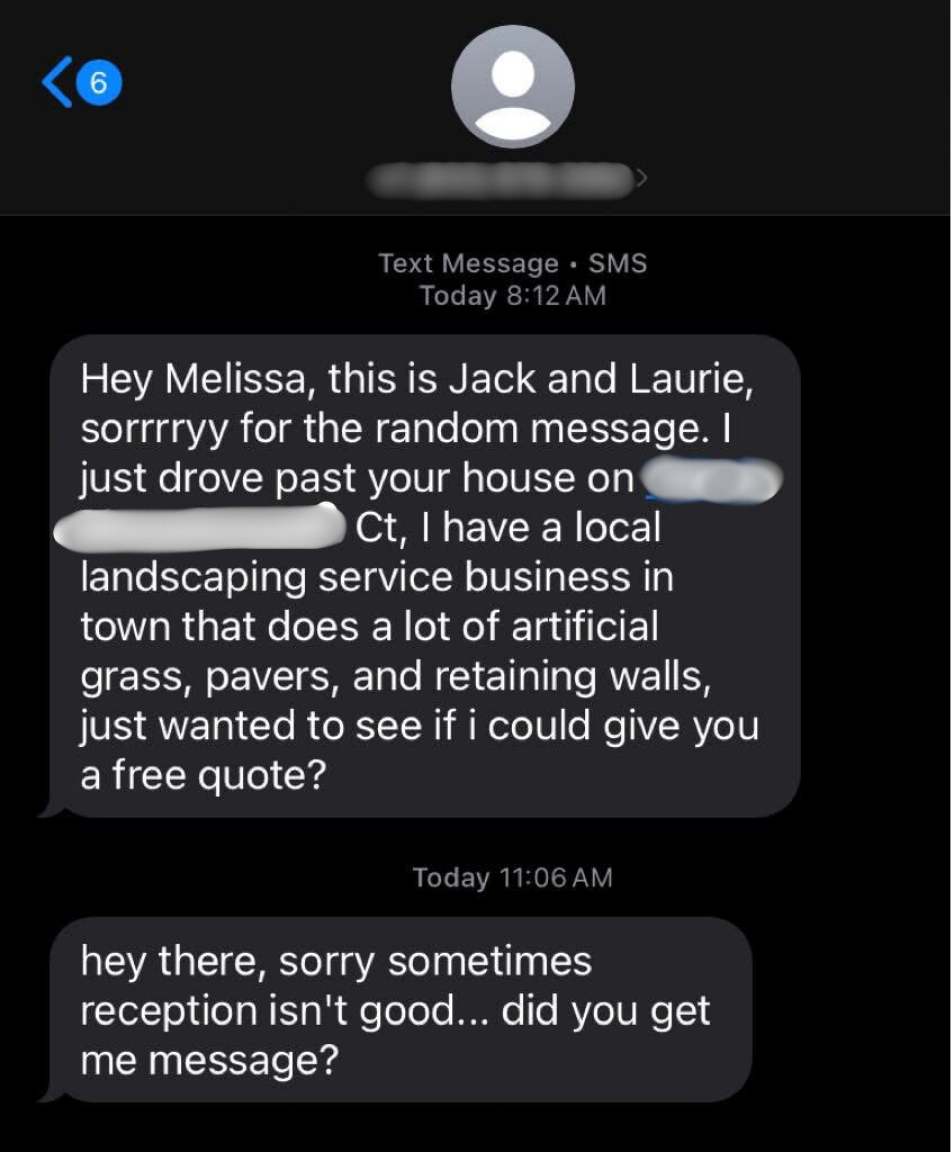
The example below shows how a home repair scammer typically presents their offer - appearing helpful and professional while setting up the conditions for fraud.
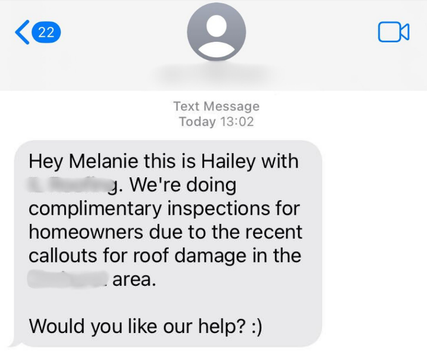
The pitch combines urgency (damage that needs immediate attention), apparent expertise (the contractor noticed what you could not see yourself), a time-limited deal (materials available only today), and a price that seems like a bargain. Each element is designed to make moving quickly feel smart rather than risky. A legitimate contractor is comfortable giving you time to verify their license, check references, and get competing quotes - because they know their work will stand up to scrutiny.
Typical approaches sound like: "I was doing a roof on Miller Street and I couldn't help noticing your ridge cap is lifting - you've got water getting in there right now. I have materials on my truck and I can fix it today for $800 cash, which is way below what anyone else would charge," and "We specialize in post-storm insurance claims - you pay nothing, your insurance covers everything, and we make sure you get the maximum payout. Just sign here and we'll handle it from here."
Warning Signs
These signals consistently indicate a home repair contractor may be fraudulent or predatory.
- The contractor appeared at your door uninvited, rather than arriving in response to a call you made.
- They claim to have "just noticed" a problem while working nearby - particularly roof damage, foundation issues, or structural concerns that you cannot easily verify yourself.
- The deal is only available today because they have leftover materials, a nearby job, or a limited-time price. Pressure to decide immediately prevents you from getting competing quotes or verifying credentials.
- They request a large upfront payment - more than 15 to 20 percent of the total - before any work begins, or ask for cash or a check made out to an individual rather than a business.
- They cannot provide proof of licensing and insurance when asked, or provide documentation that cannot be independently verified through your state's contractor licensing database.
- They offer to handle your insurance claim directly and receive payment from your insurer on your behalf. This arrangement creates significant risk that insurance proceeds will be misappropriated.
- They want you to sign a contract immediately, before you have had time to read it carefully or have anyone else review it.
- No written contract is offered - only a verbal agreement or a vague receipt that does not specify the scope of work, materials, timeline, and payment schedule.
Who Scammers Often Target
Home repair scams disproportionately target older homeowners, particularly those who live alone and are less likely to have a second person available to consult before making a decision. Older homeowners are also more likely to own property with genuine deferred maintenance, making claimed problems more plausible.
Homeowners in areas recently affected by storms, flooding, or other weather events are intensively targeted. The presence of real neighborhood damage makes the contractor's claimed concerns more believable and the homeowner's anxiety more acute.
People who are less comfortable assessing construction work themselves - unable to climb on a roof or inspect a foundation - are easier to deceive with fabricated or exaggerated damage claims.
What the Scammer Is Trying to Achieve
The goal is the upfront payment - collected before any work is done and before the victim has verified the contractor's legitimacy. Because home repairs can legitimately cost thousands of dollars, a scammer who collects even a partial payment can make a significant amount from a single interaction before disappearing.
In insurance claim versions, the goal is the insurance payout itself - which the contractor directs to themselves while performing minimal or no actual repair work on the property.
What To Do If You Encounter This Scam
If an unsolicited contractor appears at your door with an urgent repair offer, here is the safest response.
- Do not agree to anything on the spot. Thank them for stopping by and say you will be in touch. A legitimate contractor will leave a card and follow up - a scammer will often become more aggressive when you do not commit immediately.
- Ask for their contractor's license number and insurance certificate. Look up the license through your state's contractor licensing board online before agreeing to any work.
- Get at least two to three competing quotes from contractors you found independently - through referrals, your state licensing board, or established review platforms.
- Never pay more than 10 to 15 percent upfront, and make payment by check to a verified business entity - not cash and not to an individual's name.
- Report aggressive or fraudulent door-to-door contractor approaches to your state attorney general's consumer protection office and to the FTC at ReportFraud.ftc.gov.
How To Prevent Home Repair Scams
These habits protect you from the most common forms of contractor fraud.
- Never hire a contractor who came to your door uninvited. Find contractors through referrals from people you trust, your state licensing board, or established review platforms - not through door-to-door solicitation.
- Always verify licensing and insurance independently before signing any contract. Your state's contractor licensing board maintains a searchable online database.
- Get at least two to three written quotes for any significant repair project. This provides a realistic sense of fair pricing and makes inflated or artificially low bids obvious.
- Limit upfront payments to 10 to 15 percent of the total job cost. Pay by check made out to the contractor's verified business name, which creates a paper trail and limits your exposure if the contractor disappears.
- Read the contract carefully before signing. It should specify the scope of work, materials to be used, the timeline, the payment schedule, and what happens if the work is not completed as described.
Final Safety Advice
Home repair scams succeed by combining a real concern - your home's condition - with manufactured urgency that prevents the due diligence that would expose the fraud. The "today only" price, the "leftover materials," the storm damage you can see from the street but cannot verify yourself: these are all elements of a script designed to move you from concern to commitment before you have had a chance to think carefully.
Taking one day before agreeing to any significant home repair - enough time to verify a license, get a second quote, and ask a family member or trusted neighbor for input - breaks this script entirely. Legitimate contractors are not threatened by that pause. Scammers are.
If you have already paid and the contractor has disappeared, report it promptly and pursue your legal options through your state licensing board and consumer protection office. Many contractor fraud cases are recoverable through these channels, particularly when the contractor held a license that can be sanctioned.