
Gift Card Scam
Why scammers demand gift cards as payment - and how to recognize this tactic no matter what story surrounds it
Gift cards have become the preferred payment method for scammers across nearly every type of fraud - from grandparent scams to IRS impersonation - because once the card numbers are shared, the money is gone and cannot be recovered.
In This Guide
Overview of the Scam
Gift card scams occur when someone pressures or tricks you into purchasing gift cards - Google Play, iTunes, Amazon, Target, Walmart, or others - and sharing the card numbers over the phone, by text, or via email. The story that prompts the purchase varies widely, but the payment method is always the same: gift cards.
Gift cards have become the preferred payment method for scammers of all types because they are immediate, nearly untraceable, and impossible to reverse. Once a scammer has the card number and PIN from the back of the card, the balance can be drained in seconds. There is no bank to call, no transaction to dispute, and no way to get the money back.
The gift card demand is not a type of scam on its own - it is the payment mechanism used across dozens of different scam types. Understanding that no legitimate person, government agency, or business will ever ask you to pay using gift cards is one of the most broadly protective pieces of knowledge you can have.
How the Scam Works
Gift card scams are usually embedded inside other scams. The story varies, but the payment request follows the same pattern every time.
- You receive a phone call, text, or email presenting an urgent situation. Common scenarios include: a family member in trouble, a government agency threatening arrest or penalty, a tech support crisis requiring immediate payment, a prize you have won that requires a processing fee, or an employer sending you on a purchasing errand.
- The story creates pressure to act quickly. You are told that payment must be made immediately to avoid serious consequences - arrest, service shutoff, loss of a prize, or your grandchild remaining in jail.
- You are instructed to go to a store - often a grocery store, pharmacy, or big-box retailer - and purchase gift cards. The scammer may stay on the phone with you the entire time to maintain the pressure and prevent you from speaking with store employees about what you are doing.
- Once you have the cards, you are asked to scratch off the back and read the card numbers and PINs over the phone, send them by text, or enter them on a website. The scammer records these numbers immediately.
- The card balances are drained within minutes, often before you even hang up the phone. The money is transferred and dispersed in ways that make recovery nearly impossible.
Common Variations
Gift card payment demands appear in many different scam contexts. Here are the most common scenarios in which this tactic is used.
- IRS or government impersonation: A caller claims to be from the IRS and says you owe back taxes that must be paid immediately to avoid arrest. They instruct you to purchase gift cards to settle the debt.
- Grandparent scam: A caller claims your grandchild has been arrested and needs bail money right away. You are told to buy gift cards and share the numbers to cover the cost. This scenario is covered in more detail in our Grandparent Scam guide.
- Tech support scam: Someone claiming to be from Microsoft or Apple says your computer has been infected and a fee is required to fix it. They direct you to purchase gift cards as payment for the repair service.
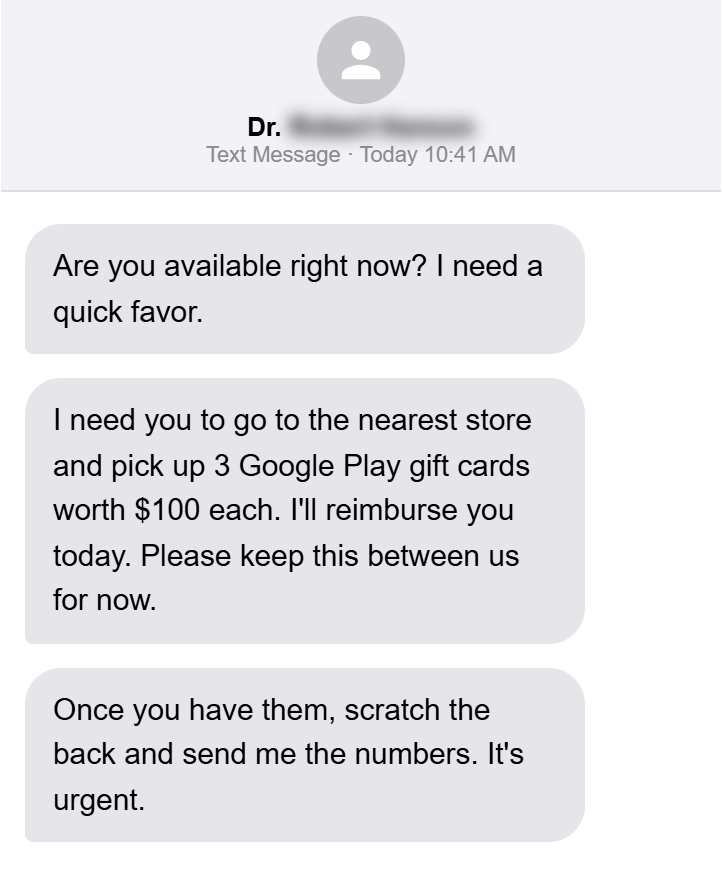
- Boss or coworker impersonation: You receive a text or email appearing to come from your employer asking you to purchase gift cards for a work purpose - a client gift, an office supply emergency - and share the numbers. The email address is slightly wrong but easy to miss.
- Romance scam payment: After weeks of building a relationship online, the person you have been communicating with hits a crisis and needs money immediately. They ask for gift cards rather than a bank transfer because it is "faster and simpler."
- Utility shutoff threat: A caller claims to be from your electric or gas company and says your service will be shut off within the hour unless you pay an overdue balance with gift cards. This scam is covered further in our Utility Shutoff Scam guide.
Example Scam Messages or Pop-Ups
The example below shows the type of communication used to set up a gift card payment demand. Notice how the urgency and authority are layered together to prevent the recipient from pausing to think.
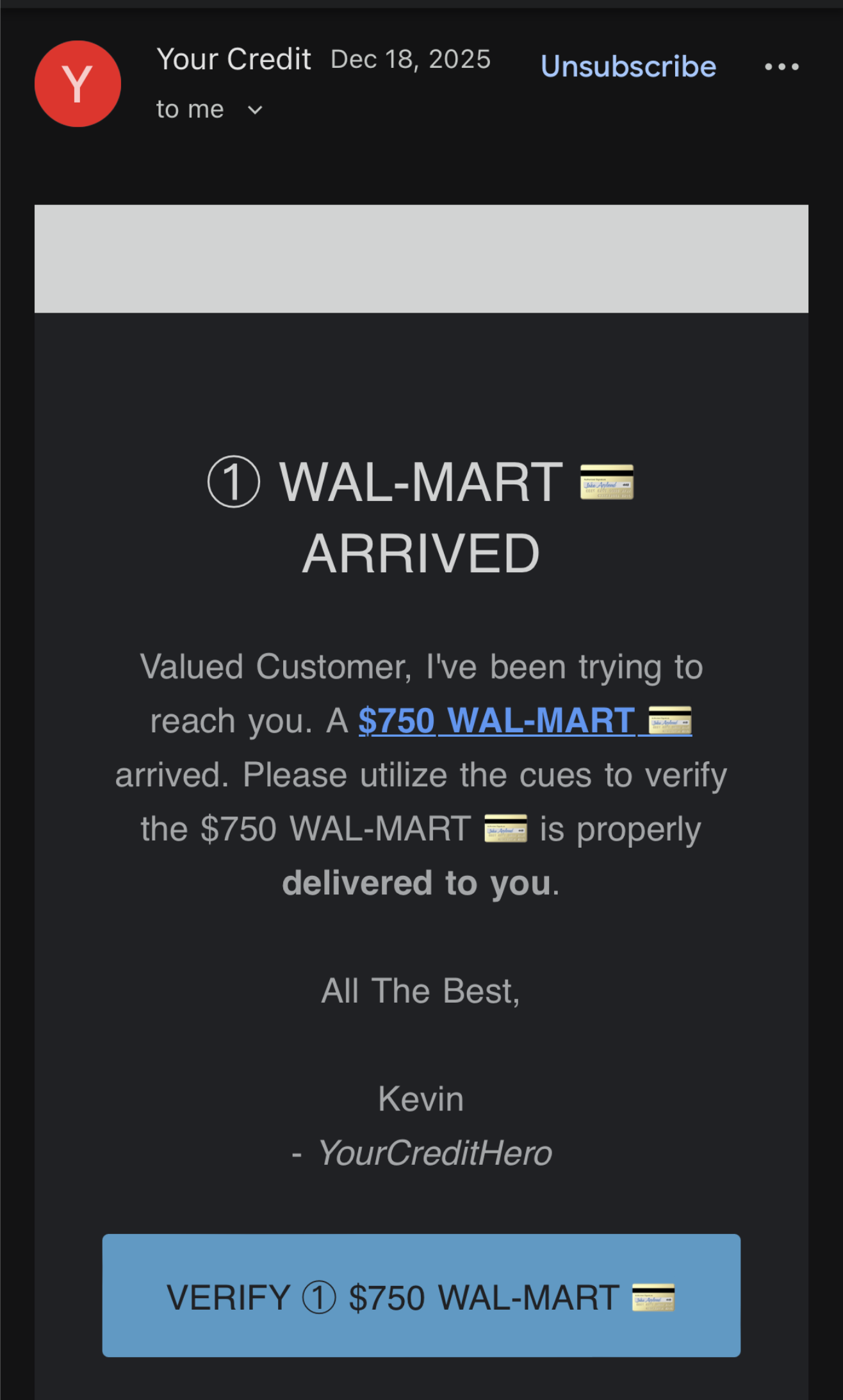
The message uses authoritative language, a sense of immediate urgency, and sometimes the threat of legal consequences to push the recipient into acting without stopping to verify. The specific cards requested - Google Play, iTunes, Amazon - are chosen because they are widely available in grocery and convenience stores and can be redeemed globally almost instantly once the numbers are shared.
Common phrasing in gift card scam calls includes: "The only way to stop this warrant from being executed is to settle your tax debt today using Google Play cards," "I need you to go to CVS right now and buy five $200 Amazon gift cards - do not tell anyone why, this is a legal matter," and "Your Microsoft subscription has flagged suspicious activity on your account - to protect your funds, we need you to purchase iTunes cards for a secure transfer."
Warning Signs
The following signals indicate that a payment request involving gift cards is fraudulent.
- Anyone - by phone, text, or email - asks you to pay for anything using gift cards. This is the defining signal of a scam. No legitimate payment ever requires gift cards.
- The caller stays on the phone with you while you travel to the store to buy the cards, maintaining pressure and preventing you from speaking to anyone about the situation.
- The request involves unusual urgency - a warrant about to be executed, a service about to be cut off, a family member who will remain in custody - unless you act in the next hour.
- You are told to keep the purchase secret or not to tell anyone what the cards are for, including store employees.
- The caller asks you to read the card numbers and PINs aloud or send them by text or photo immediately after scratching the back of the card.
- The scenario involves a government agency - the IRS, Social Security Administration, Medicare, or law enforcement - demanding immediate payment. These agencies do not collect payments by phone and do not accept gift cards.
- You are asked to purchase a specific type or brand of gift card - Google Play, iTunes, eBay, or others - rather than being given any flexibility on payment method.
Who Scammers Often Target
Gift card scams are used in so many different fraud scenarios that the target population spans virtually everyone - but older adults are disproportionately affected. Scammers who use government impersonation, grandparent scenarios, and tech support stories specifically seek out older adults because these scenarios tend to resonate more strongly with that demographic.
People who are experiencing financial stress are also frequently targeted, because the threat of immediate consequences - arrest, service shutoff, legal action - is more frightening when someone is already worried about their finances.
Employees who handle purchasing or administrative tasks at small businesses are targeted by boss impersonation scams, which are specifically designed to exploit the instinct to follow instructions from authority figures quickly and without question.
What the Scammer Is Trying to Achieve
The goal is cash that cannot be traced or recovered. Gift card balances can be drained immediately once the numbers are known, and the funds are typically laundered through a chain of digital transactions that makes recovery impossible.
Scammers prefer gift cards to wire transfers or cryptocurrency for some victims because they are more accessible - virtually anyone can walk into a CVS or Walmart and purchase a gift card with cash - and because the transaction feels more like a purchase than a money transfer, which can make the payment feel less alarming in the moment.
What To Do If You Encounter This Scam
If you receive a request to pay with gift cards, here is the appropriate response.
- Hang up or stop responding. Any demand for gift card payment is a scam, regardless of how official or urgent it sounds. You do not owe an explanation or a callback.
- Do not purchase any gift cards. If you are already at the store, do not complete the purchase. Tell a store employee what is happening - many are trained to assist in exactly this situation.
- Verify the situation independently if the scenario seems at all plausible. If a caller claims to be from the IRS, hang up and call the IRS directly at their published number. If a caller claims your grandchild is in trouble, call your grandchild directly.
- Report the attempted scam to the FTC at ReportFraud.ftc.gov and to your local police department if you were specifically threatened.
- Warn family members and friends, particularly older relatives, about what you experienced. These scams are volume-based - the more people who recognize them, the fewer victims there are.
How To Prevent Gift Card Scams
One rule prevents this scam entirely, regardless of how it is packaged.
- Never pay anyone with gift cards. Not the IRS, not a bail bondsman, not a tech support agent, not a utility company, not a lottery organization. This payment method is used exclusively by scammers. No exceptions.
- Tell the people in your life - particularly older relatives - that no government agency or legitimate business ever asks for gift card payment. Sharing this knowledge is one of the most practical protections you can offer someone you care about.
- If you receive an urgent call demanding payment, hang up and call the organization back using a number you look up independently. Do not use any number the caller provides.
- Take your time. Scammers create urgency because they need you to act before you think. A real legal or financial problem will still exist after you take ten minutes to verify the situation with a family member or independent contact.
- Be aware of the boss impersonation version if you work in any role that involves purchasing. Verify any unusual financial request from a manager through a phone call or in-person conversation before acting on a text or email alone.
Final Safety Advice
Gift cards are a wonderful thing - for birthdays, holidays, and everyday giving. They become dangerous only when someone outside your personal life asks you to use them as payment. That request, in any context, is the scam itself.
The single piece of knowledge that stops every version of this fraud is this: no legitimate person or organization - not the IRS, not a lawyer, not a tech support agent, not a bail bondsman, not a prize organization - will ever instruct you to pay using gift cards. If you hear that request, you can stop the conversation immediately and be correct every single time.
If you have already been affected, please do not carry the weight of it alone. Report it to the FTC, talk to someone you trust, and know that this scam has successfully targeted many careful, intelligent people. The urgency and authority these calls manufacture are specifically designed to override the instincts that would otherwise protect you.