
Funeral & Obituary Scam
How scammers exploit public obituaries and funeral arrangements to target grieving families at their most vulnerable moment
Funeral and obituary scams target families in the days surrounding a death - when grief is acute, decisions must be made quickly, and the normal protective instincts that catch fraud are at their lowest.
In This Guide
- Overview of the Scam
- How the Scam Works
- Common Variations
- Example Scam Messages or Pop-Ups
- Warning Signs
- Who Scammers Often Target
- What the Scammer Is Trying to Achieve
- What To Do If You Encounter This Scam
- If You Already Paid or Shared Information
- How To Prevent Funeral & Obituary Scams
- Final Safety Advice
Overview of the Scam
Funeral and obituary scams target bereaved families in the days immediately surrounding a death - a period when people are emotionally overwhelmed, making rapid decisions under time pressure, and far less likely to scrutinize suspicious contacts. Scammers mine public obituaries for names, family details, and funeral arrangements, then use this information to appear credible when approaching grieving relatives with fraudulent claims or offers.
These scams range from strangers claiming the deceased owed them money, to predatory funeral home upselling, to identity thieves who use a death notice to open new accounts in the deceased person's name before the family has notified financial institutions. In all cases the timing is deliberate: the period of maximum grief is also the period of minimum vigilance.
Understanding what to expect - and what to be suspicious of - in the days following a death is one of the most practically protective things a family can have, precisely because it is impossible to think clearly about fraud while processing profound loss.
How the Scam Works
Funeral and obituary scams use publicly available death information to approach families with false claims or manipulative offers.
- A scammer reads a public obituary - in a newspaper, on a funeral home website, or posted on social media - and collects the deceased person's name, surviving family members' names, the funeral home being used, and the date and location of services.
- Using this information, the scammer contacts the family by phone, mail, or in person at the funeral home. They may claim to be a creditor of the deceased, a distant acquaintance, a vendor owed payment, or a representative of a financial institution - all with sufficient detail to seem credible.
- Grieving family members, already overwhelmed and trying to handle numerous arrangements simultaneously, may agree to pay claimed debts or provide information without the verification they would normally apply.
- In predatory funeral home schemes, a family that has not pre-arranged services is pressured into purchasing more expensive options than necessary - using grief and the implied social expectation of a dignified service to override price sensitivity.
- In identity theft versions, the deceased person's Social Security number and other identifying information are used to file fraudulent tax returns, open new credit accounts, or redirect benefit payments before the death has been officially reported to relevant agencies.
Common Variations
Funeral and obituary scams take several distinct forms depending on what the scammer is targeting.
- Fake debt collection: A caller claims the deceased owed money - on a loan, a medical bill, a personal debt - and pressures surviving family members to pay immediately. The debt may be fabricated entirely, may already have been paid, or may be a real debt that family members are not personally obligated to cover.
- Funeral home at-need upselling: A family arranging funeral services without pre-planning is steered toward the most expensive options through emotional pressure, implied social expectation, or misleading statements about what is legally required. The FTC's Funeral Rule requires funeral homes to provide itemized pricing - knowing this protects families.
- Flower and memorial tribute scam: A fraudulent company contacts the family claiming to have a standing order for flowers or a memorial tribute from the deceased, requesting payment to complete or deliver it. No such order exists.
- Ghost creditor at the funeral: Someone approaches family members at the funeral home or service claiming to be a friend or business associate the deceased owed money to. The social pressure of the setting makes it harder to decline or question the claim.
- Deceased identity theft: Using information from an obituary, a scammer files a fraudulent tax return in the deceased person's name to claim their final tax refund, opens new credit accounts, or redirects Social Security payments before the death is formally reported.
Example Scam Messages or Pop-Ups
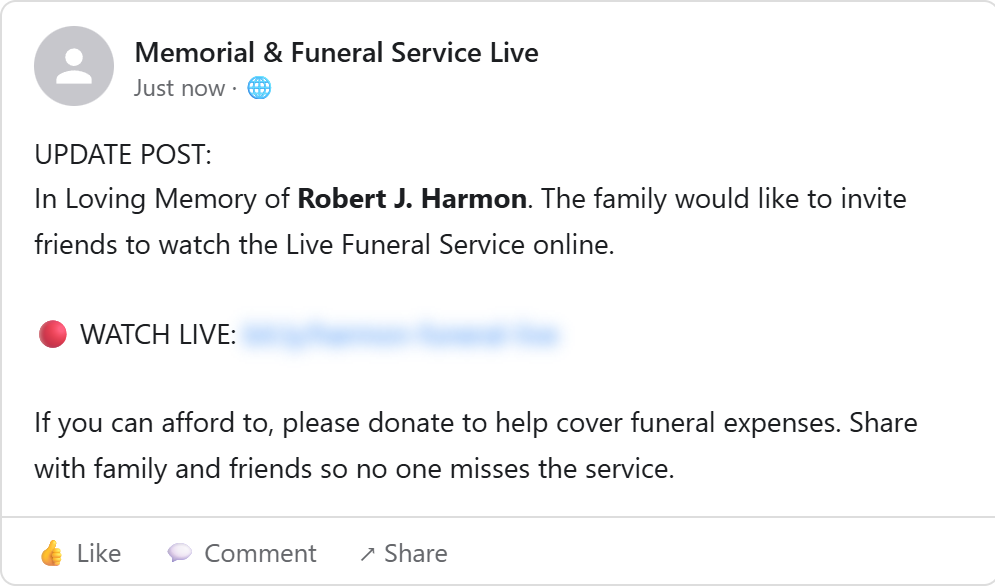
The example below shows the type of contact made by scammers who use obituary information to approach grieving families. The combination of personal detail and emotional timing makes these contacts difficult to immediately dismiss.
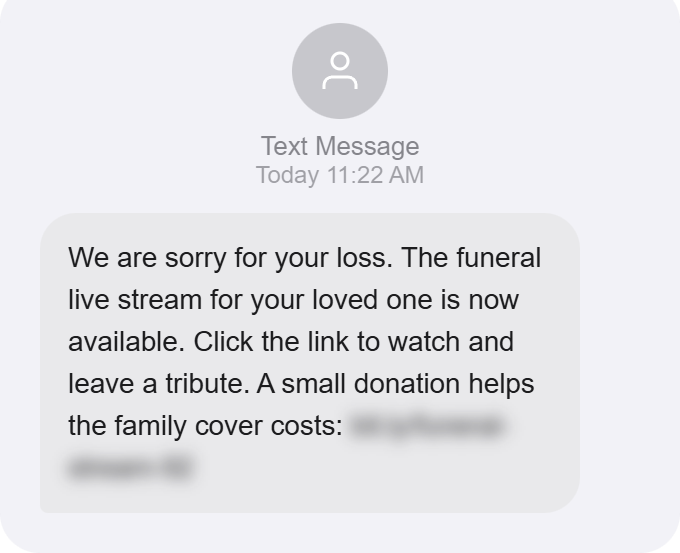
The contact uses the deceased person's name and personal details drawn from the obituary to establish credibility. The claim is presented as urgent - a debt that must be resolved before the estate can be settled, or before additional fees accumulate. The combination of apparent insider knowledge and time pressure is designed to bypass the normal verification a family would otherwise apply. Legitimate creditors follow established estate processes - they do not call family members demanding immediate personal payment.
Common approaches include calls saying: "I was a business partner of your father and he owed me $3,200 that we need to settle before the estate closes," "Your mother had an outstanding balance with our medical billing service - we need payment before we can release her final records," and letters claiming an unpaid subscription or service contract that must be honored by the estate, with no supporting documentation provided.
Warning Signs
These signals indicate that a contact following a death may be fraudulent rather than legitimate.
- A caller demands immediate personal payment for a debt of the deceased - particularly within the first few days after the death when the family is most overwhelmed and least able to verify claims.
- The caller has details from the obituary - the deceased's name, the family members' names, the funeral home - but cannot provide verifiable documentation of the debt they are claiming.
- You are told you are personally responsible for the debt as a surviving family member. In most cases this is not legally true - debts are paid from the estate, not by relatives personally.
- Payment is demanded via gift card, wire transfer, or another untraceable method. Legitimate creditors accept checks payable to their verified business entity.
- A funeral home representative pressures you to decide on expensive services immediately, implies that less expensive options are disrespectful, or declines to provide itemized pricing when asked.
- Someone at the funeral service or reception approaches you claiming the deceased owed them money and asks for payment in person.
- You receive a call from a government agency about the deceased's benefits or accounts within days of the death - before you have had a chance to notify relevant agencies yourself.
Who Scammers Often Target
These scams specifically target surviving spouses and adult children of the deceased - the family members most likely to be named in the obituary, most likely to be handling affairs, and most emotionally compromised in the immediate aftermath of a loss. The more detailed the obituary, the more information scammers have to work with.
Families who did not pre-plan funeral arrangements are more vulnerable to at-need upselling because they are making significant financial decisions under time pressure and emotional duress, without the benefit of having thought through their preferences in advance.
Older surviving spouses are particularly targeted because they may have less familiarity with their late partner's finances, may be more trusting of authority-sounding callers, and may be more emotionally isolated in the immediate period after a death.
What the Scammer Is Trying to Achieve
Fake debt callers seek immediate payment - typically a few hundred to a few thousand dollars - from family members who are too overwhelmed to verify the claim before paying. Predatory funeral services seek maximum revenue from families who are not price-shopping under normal conditions. Identity thieves seek the deceased person's Social Security number and identifying information to commit financial fraud before the death is reported to credit bureaus and government agencies.
The timing - the days immediately following a death - is the core of the strategy. Grief and logistical overwhelm create a brief window in which normal protective instincts are suppressed, and scammers are specifically designed to exploit that window.
What To Do If You Encounter This Scam
If you receive a suspicious contact following the death of a family member, here is how to protect yourself and the estate.
- Do not make any payment in response to a phone call claiming the deceased owed money. Ask the caller to submit their claim in writing to the estate's executor or attorney. A legitimate creditor will do this willingly.
- Consult an estate attorney or the executor of the estate before paying any claimed debt. In most cases, surviving family members are not personally responsible for a deceased person's debts.
- At the funeral home, ask for an itemized price list before agreeing to any services. The FTC Funeral Rule requires funeral homes to provide this. You are entitled to select only the services you want.
- Report the death to Social Security, Medicare, the deceased's bank, and the three major credit bureaus as promptly as possible. This limits the window for identity theft using the deceased person's information.
- Report fraudulent debt claims to the FTC at ReportFraud.ftc.gov and to your state attorney general's office.
How To Prevent Funeral & Obituary Scams
These habits protect grieving families from the most common forms of this fraud.
- Consider limiting the personal detail in public obituaries - particularly home addresses, the names of all surviving family members, and the specific funeral home and service times. This reduces the information available to scammers.
- Designate one family member to handle all financial and estate-related inquiries in the days following the death. Centralizing this function reduces the chance of a fraudulent claim slipping through in the chaos of the immediate aftermath.
- Report the death to financial institutions, Social Security, Medicare, and the major credit bureaus promptly. You can request a "deceased" flag on credit reports through Equifax, Experian, and TransUnion, which helps prevent new accounts being opened in the deceased's name.
- Know that you can ask funeral homes for itemized pricing and that you are not required to purchase packages. The FTC Funeral Rule is specifically designed to protect consumers in exactly these circumstances.
- Pre-planning funeral arrangements - even informally documenting preferences - reduces the pressure on surviving family members to make financial decisions under acute grief.
Final Safety Advice
The cruelty of funeral and obituary scams lies in their timing. The days following the death of someone you love are among the most difficult of your life, and scammers have calculated that grief creates a window of vulnerability that can be exploited. That knowledge - that scammers specifically target this period - is itself a form of protection, because it allows you to apply a layer of skepticism to unexpected contacts even when your capacity to think analytically is reduced.
The most protective habits are simple: ask for everything in writing, do not pay claimed debts by phone, and know that you are generally not personally responsible for the debts of someone who has died. An estate attorney can help you navigate legitimate creditor claims through proper channels without the pressure of a phone call demanding immediate payment.
If you have already been affected, please do not add the weight of this to your grief without seeking help. Report it, consult with an attorney, and know that reaching out for support - financial, legal, or emotional - in the aftermath of loss is always the right thing to do.